

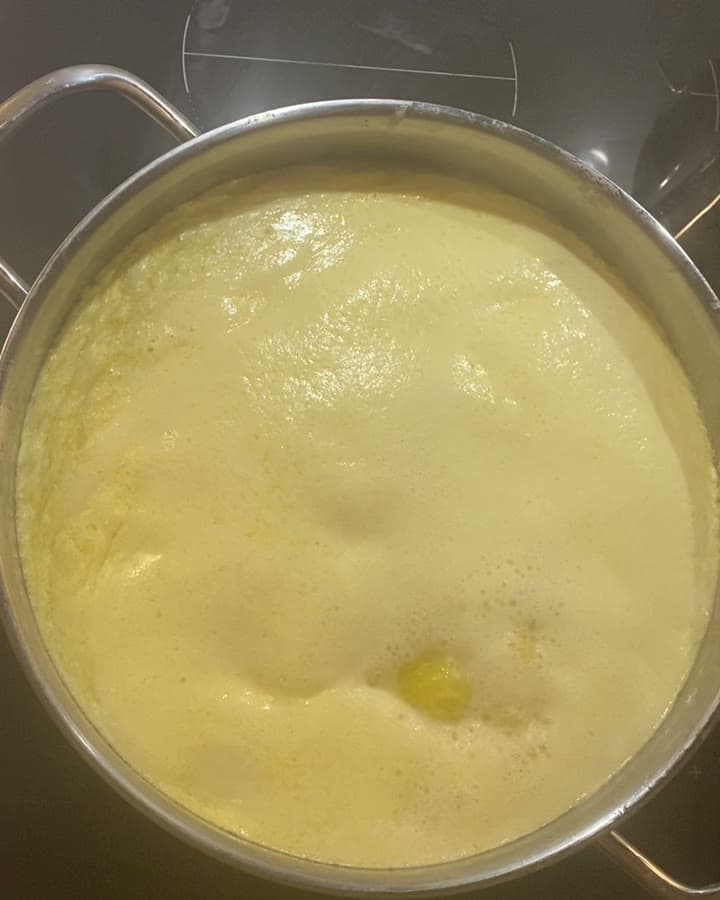
You know the moment. There's milk on the stove and you're standing right next to it. Then your phone rings, you turn away for one second, and when you turn back it's everywhere. And what we always say is the same: it just boiled over.
But it didn't just boil over. First it warmed up. Tiny bubbles gathered at the edges, the surface started to tremble, then it rose. Every one of those steps happened in plain sight. We just weren't looking.
This is how most of us live with our bodies. We believe illness shows up out of nowhere. If that's what you believe, chances are you simply missed the whispers. The body whispers first, and only then does it shout. And your body comes with a user manual. Have you ever had the chance to read it?
According to Ayurveda, an imbalance moves through six stages. By the time most of us walk into a doctor's office, we're at stage four at the very least, and more often at five or six. When someone asks how we are, we say "fine, thanks". When we catch a cold, we say we've come down with something. As if there were nothing in between being well and being sick. In Ayurveda, illness starts long before that, and every step of the road in between has a name.
The classical texts call these six stages shat kriya kala. Shat means six, kriya means intervention, kala means time: literally, "six times to intervene". The name says it all. Every stage is a moment when we can step in. I like to explain them using exactly that pot of milk on the stove.
The first stage is accumulation, sanchaya. The milk has risen to the rim but hasn't spilled. Turn the stove off right then and you drink your milk; nobody would ever know anything happened. In the body, one of the doshas has increased but is still in its own place. (Ayurveda speaks of three doshas: vata, pitta and kapha. Each is formed by the two strongest of the body's five elements working together.) There's no disease yet, only small, scattered signs. No blood test will show it, and nobody gives it a name. This is the point I always underline most: at the accumulation stage, balance is easiest to restore and hardest to notice.
Leave the stove on and we reach the second stage: aggravation, prakopa. The milk hasn't spilled yet, but it's catching on the bottom of the pan and starting to smell a little burnt. The dosha is still where it belongs, but now it's restless, and it starts to bother you.
Then comes spreading, prasara. The milk runs over the rim; first the stove gets messy, then the counter. The dosha overflows its home too and starts travelling through the body's channels. We all know these first three stages. We live with them constantly: dry skin, a ringing in the ear now and then, the odd headache, nails that break easily, gums that bleed easily. The stuff of everyday life we don't think twice about.
Stage four is settling, sthana samshraya. The milk is running down the front of the stove now, and the first drop lands on your foot. Pull your foot away at that moment and you get away with a little redness. The overflowing dosha doesn't go just anywhere in the body, either. It leaves strong, healthy tissue alone; it finds the weakest spot and settles there. For some people that's the gut, for others the joints, for others sleep.
Stage five is manifestation, vyakti. You didn't move your foot, the milk kept pouring, and now there's a real burn. It hurts, and you can see it. In the body, the problem has come out into the open, and this is roughly when most of us knock on the doctor's door. Stage six is complication, bheda. If you tell yourself "I'm strong, I can handle it" and keep standing at the stove, the burn deepens and becomes a wound. The problem branches out and gives rise to new ones.
whisper
- Sanchaya(Accumulation)The milk is rising but hasn't spilled
- Prakopa(Aggravation)It's caught on the bottom and smells burnt
- Prasara(Spreading)It has boiled over onto the stove
shout
- Sthana samshraya(Settling)A drop lands on your foot
- Vyakti(Manifestation)A burn appears on your footmost of us see a doctor here
- Bheda(Complication)The burn turns into a wound
So why does the spilled milk land on one person's gut, another's joints, someone else's sleep? I love picturing this as a tree of life. Every tree has its own branches, its own fruit, its own favourite climate and soil. The sturdier your roots, the more steadily you stand. But if you don't notice the wind (stress), the drought (the wrong food), the storm (a relentless pace), your branches break. And every tree has a different branch that breaks first. Which one is decided first by the nature you were born with, then by the tendencies you inherited from your family. Where those two meet is your weak spot. Which way the stages travel is shaped by the choices we make and by life itself. Knowing your nature means learning how your own tree grows, and how it can grow stronger.
What do I actually mean by knowing your nature? Let me use myself as an example. My nature is cold, dry, light, mobile and sharp. I don't cope well with being worn out, or with eating poorly. Put it this way: if we all got stranded on a desert island together, I'd probably be one of the first to go.
When I stop looking after myself, my tree always weakens the same way. The first whisper comes from my skin; dryness shows up there before anywhere else. My physical and mental energy drop, my mind starts to dry out too, and inspiration and clarity drain away. My weight might not change, but my face loses its glow, and the low energy starts to show. If I don't listen, the whisper moves into my mind. I get scattered, I lose sight of the big picture and get lost in the small details. My anxiety climbs, and burnout is waiting at the door. For me, that's the last exit before the bridge. If I drive past that one too, my body really starts to weaken: my immunity drops, my gut flora gets thrown off, and absorption problems show up in my bloodwork. And in the end, the body shouts. Constipation, heartburn, the feeling of being stuck in life. My anxiety turns into anger at everything, and my cycle and hormones fall out of balance. I've been lucky enough never to reach the later stages.
Because I know all this, I take extra care of myself. When I see the first bit of dryness on my skin, I know exactly what it is: that's my milk, right up to the rim.
But here's the real question. If the body whispers this early, why don't we hear it?
The truth is, we do hear the whispers. We just normalise them. We say "it's fine, it's nothing". We get used to being tired. We get used to the bloating. We get used to those three days before our period. We get used to waking up exhausted. And every time we get used to something, the line we call "normal" shifts up a notch. The body has been speaking at the same volume all along. What changed was our threshold.
Then there are the things we brush aside. Some days the mind jumps from one thing to the next and we just can't pull ourselves together. That's a sign the movement inside us has picked up, and it's worth asking how we might ground ourselves. But if we brush that moment aside, what we think we've dealt with doesn't actually go away. It keeps moving forward in another part of our life; it has simply moved out of view. Like putting a lid on the pan without turning down the heat. That's why the things we say "came out of nowhere" have very often been there for years. We just didn't see them as worth counting.
That's why, in Ayurveda, feeling unwell isn't a bad thing in itself. Every symptom is a whisper, and a gift to whoever can hear it. To bring that line back down, you don't need more rules, longer elimination lists or more discipline. You need to know yourself a little more closely. Because knowing your nature isn't about controlling your body; it's about standing close enough to hear it. The way you'd stand by the milk on the stove.
Understanding your own nature, learning your manual, means noticing before you fall.